Configuring AI Actions
You can configure AI Actions in your ServiceMax org to instruct ServiceMax AI on the tasks it should perform when an end user invokes an AI Action. This configuration enables administrators to automate workflows and improve operational efficiency by defining precise AI behavior that aligns with business goals.
Use Cases
The following list represents some use cases for the AI Actions feature:
• Define AI-driven instructions for summarizing work orders.
• Insert SFM transaction references into AI Action instructions.
• Configure AI Actions for specific objects such as Work Orders or Cases.
|
Prerequisites
|
|---|
|
To enable this feature, ensure the following:
• The ServiceMax AI package is installed and configured in your Salesforce organization.
• Relevant AI agents (such as ServiceMax, Knowledge Access, SFM, and Scheduling) are enabled and accessible in the AI Console.
• User profiles have the necessary permissions to access the required agents and execute AI actions.
• SFM transactions to be used in AI actions are enabled in the SFM Agent configuration.
|
To run an AI action using the SFMs, perform the following steps.
1. Navigate to > > .
The ServiceMax AI Console is launched.
 |
You can also log in to the ServiceMax AI console directly at https://console.servicemax.io/ai with your Salesforce org credentials.
|
2. Navigate to > .
The AI Actions page is displayed.
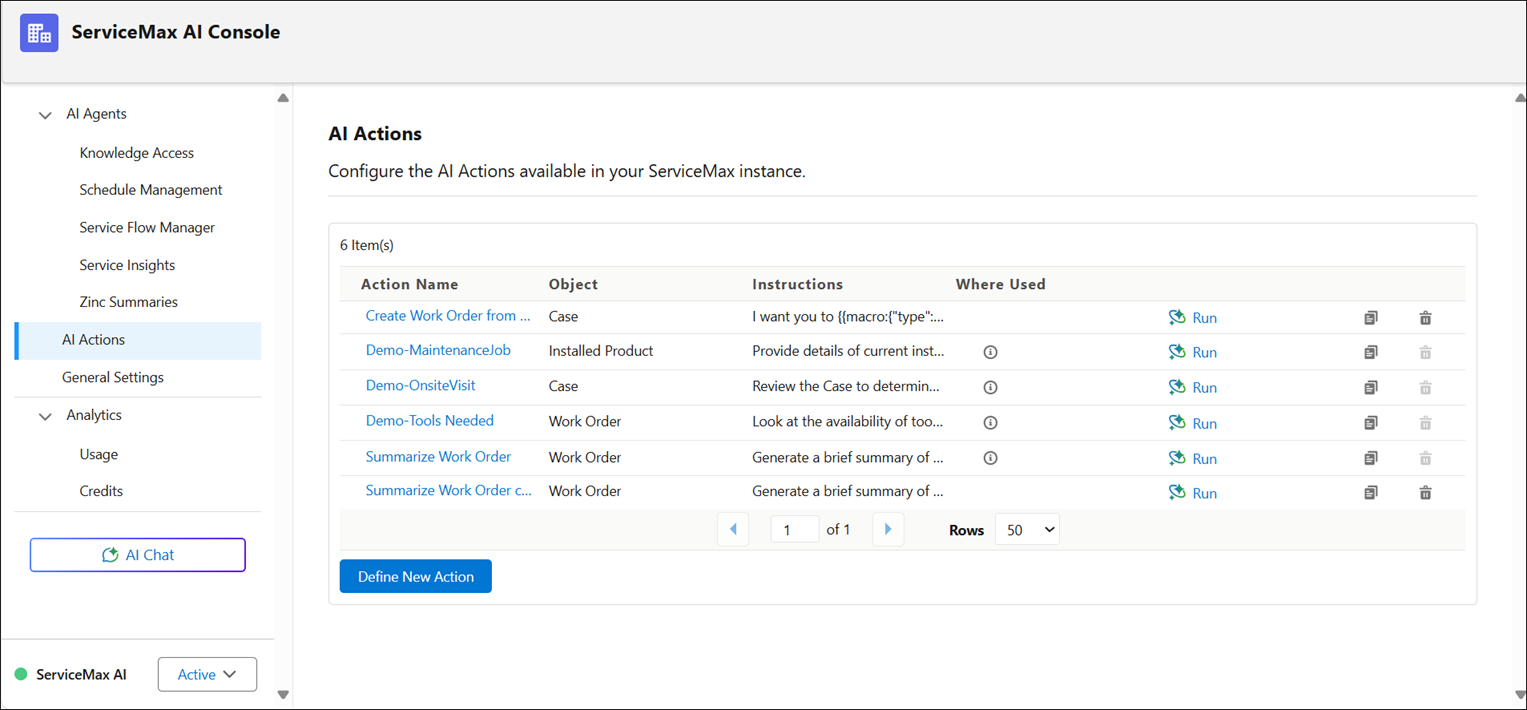
The following table describes the fields on the AI Actions page:
|
Field
|
Description
|
|---|---|
|
Action Name
|
The name of the AI action.
|
|
Object
|
The type of data the action applies to Case, Location, and Work Order.
|
|
Instructions
|
A brief description of what the AI Action should do.
|
|
Where Used
|
Indicates where the action is currently being used. For more information, see Using Where Used.
|
3. Select the AI Action you want to configure.
The AI Instructions window is displayed.
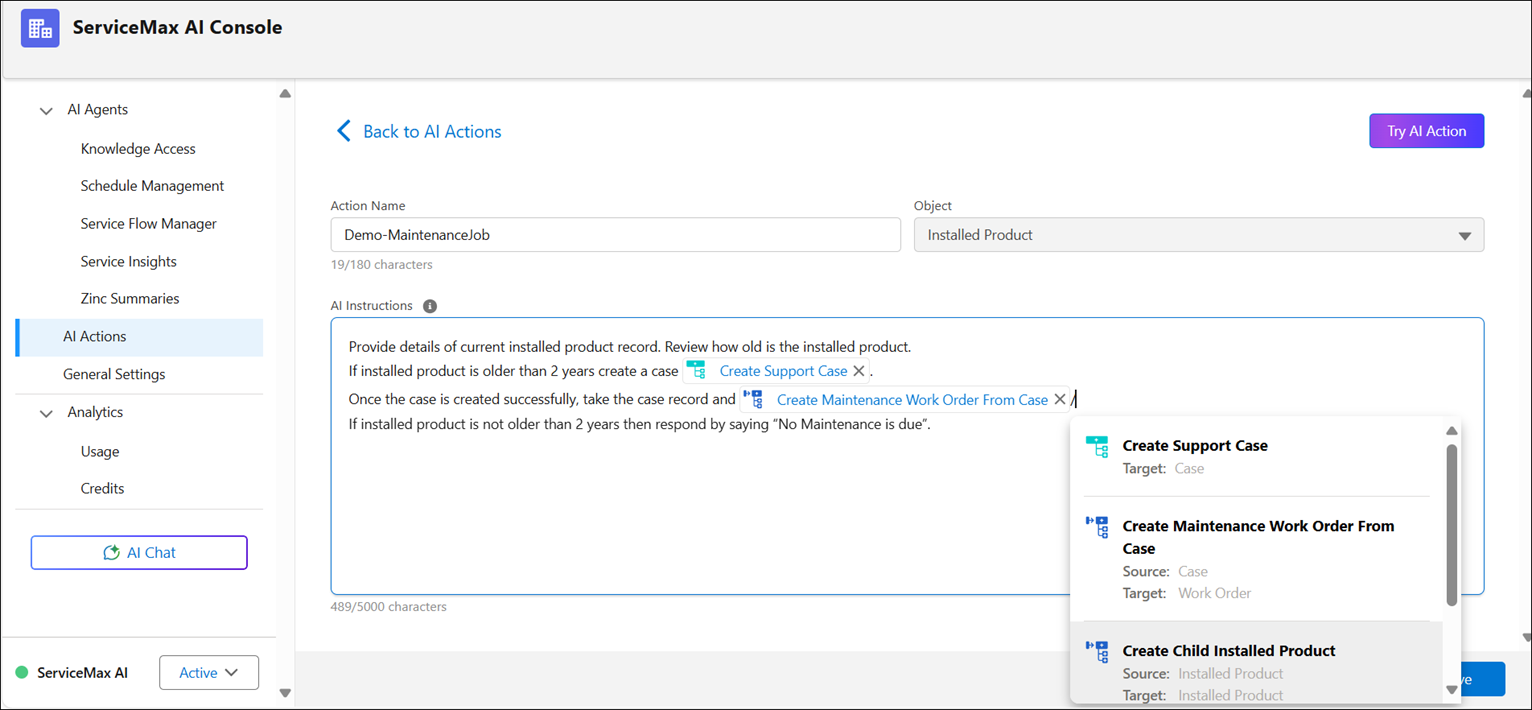
4. Enter the instructions for AI Action. For example, if you want to configure the Maintenance Job Action, specify the actions to be performed by ServiceMax AI, such as checking details of the current installed product, creating a support case, and creating a maintenance job from the Work Order.
|
|
You can use a maximum of 5000 characters to write the instructions.
|
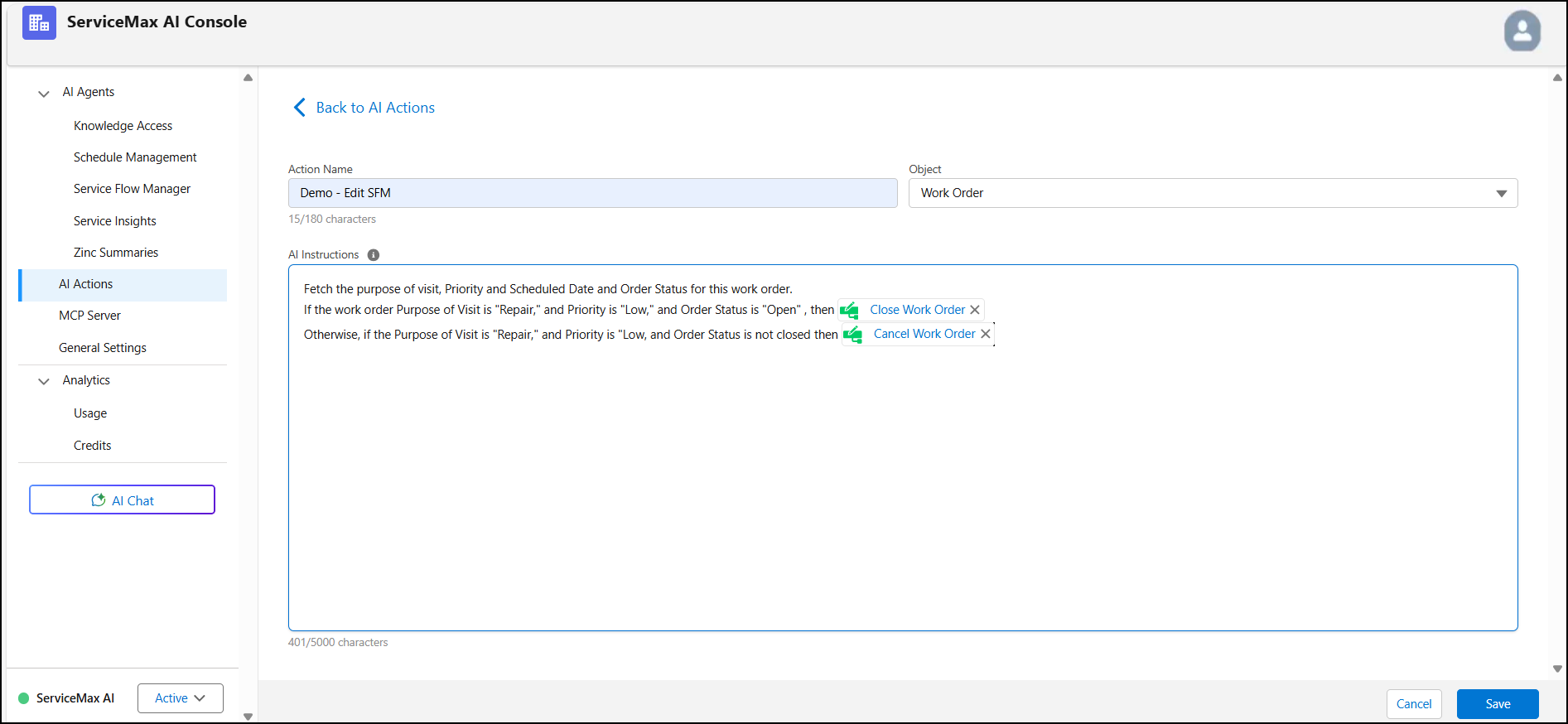
5. To insert SFM transactions, enter a forward slash (/) in the AI Instructions window.
A dropdown of enabled SFM transactions is displayed.
◦ The screenshot below is an example of how you can create a new record using the To create Standalone record and To create Target from Source SFM transactions.
◦ The screenshot below is an example of how you can update existing records using the To update existing records SFM transaction.
6. From the dropdown, select an SFM transaction.
The dropdown closes automatically, and the reference is inserted at the current cursor location or at the end of the text if no cursor is active.
7. Click Save.
8. Click Run AI Action to test the action with sample records. For more information, see Using Run AI Action.
9. Review the output and refine the instructions as needed to achieve the desired response.
The AI Action is configured and available on supported platforms. For more information, see AI Actions.
Supporting Additional Field Values in Prompts
You can specify additional field values directly in your prompt when creating or updating a record. The SFM agent parses these values and apply them to the target record, overriding any default values defined in the SFM transaction configuration.
Example Prompts:
• “Create work order for ultrasound 300. Set priority to High. Set order status to Open. Set scheduled date to today.”
• “Update work order WO-000456 with priority high and order status completed.”
|
|
The following scenarios apply when you provide additional field values to the SFM agent when creating a new record or updating an existing record:
• The SFM Agent supports multi-line and single-line prompt examples with field overrides.
• The agent parses field-value pairs from your prompt.
• The supported fields include Priority, Status, and Dates (e.g., Scheduled Date).
• If a field is specified both in the SFM configuration and your prompt, your prompt’s value takes precedence.
• The agent recognizes synonyms and natural date phrases (e.g., “today” is mapped to the current date). When specifying field values in your prompt, use clear field names and values. For dates, you can use phrases like “today” or “tomorrow.”
• If you specify a field that is not available or provide an invalid value, an error message is displayed.
|